The Smart Offer: How to Turn Market Data Into Your Best Move
Data gives you the range, but strategy gets you the keys. Learn how to bridge the gap between market numbers and a successful negotiation.

Finding a home you love is the easy part. The challenge is deciding how to move forward. Most buyers are caught in a tug-of-war between two very real fears:
- Overpaying in a moment of excitement.
- Hesitating and losing the home to someone else.
That tension is normal. A smart first move isn't about having total certainty—it’s about using data so your decisions feel thoughtful, not rushed.
The market analysis you’re reviewing provides the foundation. It shows you what’s reasonable, what’s competitive, and—most importantly—where flexibility may exist in the seller's position.
This guide helps you interpret that data so you can move forward with clarity:
- Not as a formula.
- Not as a guess.
- But as a deliberate strategy grounded in context.
"We were nervous about making an offer because we didn’t want to overpay or make a mistake we’d regret later. The data helped, but what really made the difference was having someone explain how to use it and what actually mattered in that moment. Once we understood the market and our options, making an offer felt calm and intentional instead of stressful. We ended up with a home we love and still feel confident about the decision today." - Tony & Tina (Google Review)
Table of Contents
- The Strategy of the First Move
- Defining Your Decision Threshold
- The Power of Terms Over Price
- Reading the Market’s Pulse
- Your Safety Net: Protections & Contingencies
- The Final Piece: Why Context Matters
The Strategy of the First Move
Why an offer is a question, not a final answer.
Many buyers treat an offer like a final verdict. In reality, a first move is a discovery tool—a strategic signal designed to uncover the seller's true position. Until you submit a formal "question" in writing, you are only negotiating with yourself.
Reframing the move this way provides three immediate advantages:
- It Uncovers Motivation: The seller’s counter-offer (or lack thereof) reveals more about their urgency than the listing agent ever will.
- It Stops the "Guessing Game": You move from speculating about what they might accept to getting a definitive, legal response.
- It Preserves Your Power: An offer is a starting point for a conversation. You maintain the right to walk away or renegotiate based on what the seller’s reaction reveals.
By treating the offer as a data-gathering exercise, you remove the emotional weight of "being right" about the price and focus on finding the seller's "pressure points."
Defining Your Decision Threshold
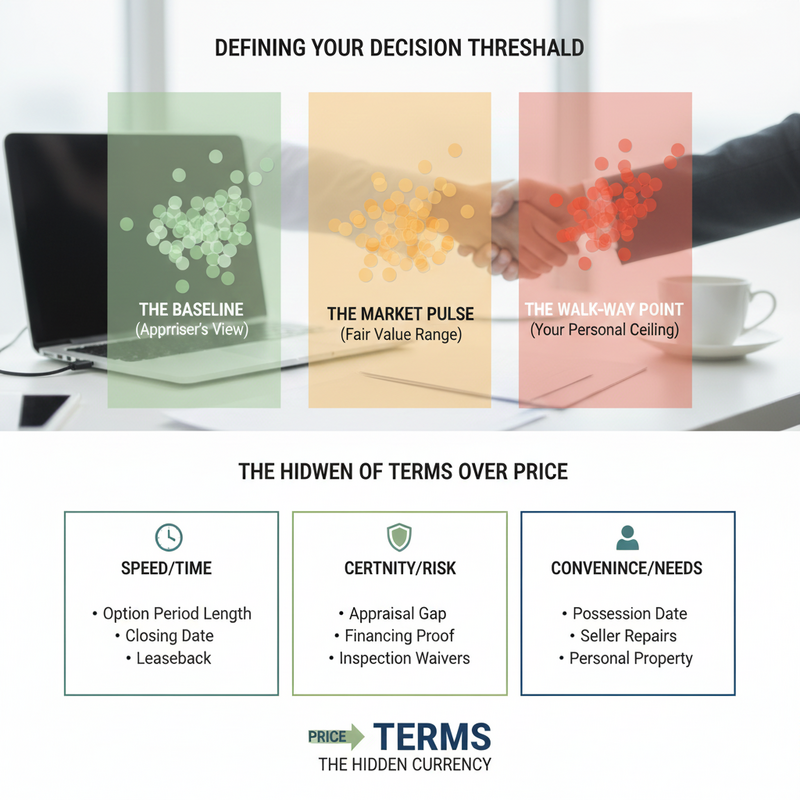
Using market data to establish a flexible reference point.
Data doesn’t provide a single "correct" price; it provides a range of probability. Your Decision Threshold is the boundary where market logic meets your personal comfort zone. Establishing this early transforms you from a reactive bidder into a disciplined buyer.
To find your threshold, categorize the market data into three zones:
- The Baseline (The Appraiser’s View): The price supported by hard facts—recent, closed sales of similar homes. This is your anchor for a "fair" offer.
- The Premium (The Motivation Factor): The extra amount you are willing to pay for a "perfect" fit or to win in a multi-offer scenario.
- The Walk-Away Point: Your absolute ceiling. Knowing this number in advance is your greatest source of leverage; it allows you to negotiate with total composure because you already know when to stop.
By defining these zones before you submit a "question" to the seller, you remove the stress of the unknown. You aren't guessing what the house is worth—you are deciding what it is worth to you.
The Power of Terms Over Price
How structure and timing can be as powerful as price.
Price is only one lever in a negotiation. In many cases, a seller will accept a lower price if the terms reduce their risk or solve a specific problem. By structuring your offer to align with the seller’s "pain points," you can often win the home without being the highest bidder.
Think of terms as the "hidden currency" of real estate. Key levers include:
- The Inspection Period (Option Period): A shorter window signals to the seller that you are serious and moving fast, reducing their time "off-market."
- Closing Timeline: Does the seller need to stay for two weeks after closing to move? Or do they need to close in 21 days? Matching their schedule can be worth thousands in their eyes.
- The Appraisal Gap: In a competitive market, offering to cover a specific portion of an appraisal shortfall provides the seller with price certainty—something a higher "list price" offer might lack.
The Goal: We identify what the seller values most—certainty, speed, or convenience—and build an offer that delivers it. When you solve the seller’s problem, they are much less likely to haggle over yours.
Reading the Market’s Pulse
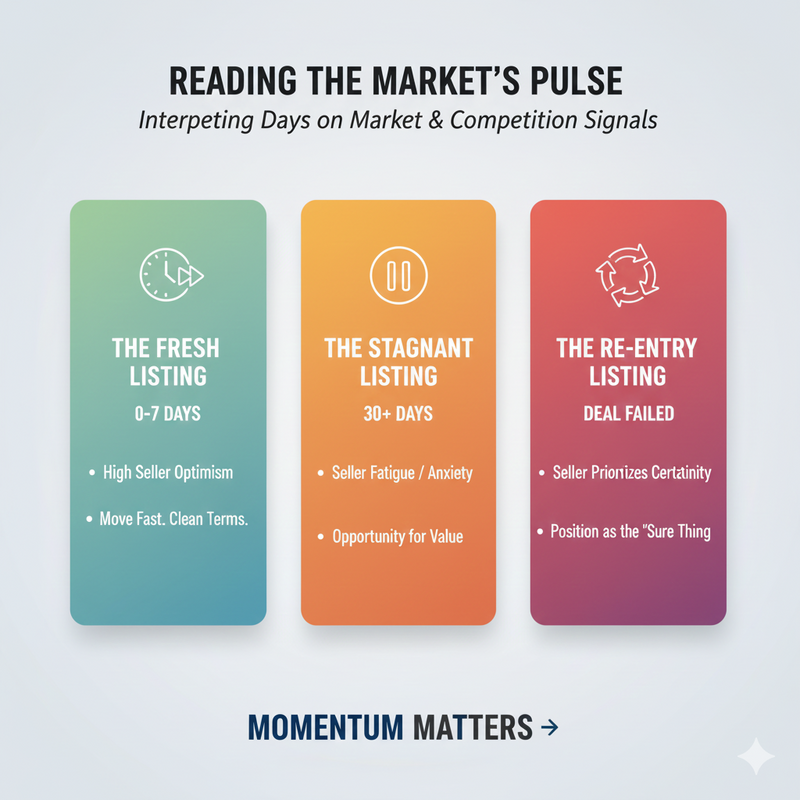
Interpreting days on market and competition signals.
Data shows you where the market was, but the "pulse" tells you where it is going. The amount of leverage you have depends heavily on the velocity and history of the listing.
To read the pulse, we look at three critical scenarios:
- The "Fresh" Listing (0–7 Days): The seller is at their peak optimism. To win here, you must move fast and lead with clean, aggressive terms. Competition is your primary risk.
- The "Stagnant" Listing (30+ Days): "Listing fatigue" has likely set in. The seller may be anxious or frustrated, creating an opening for a lower price or more favorable contingencies.
- The "Re-Entry" (Back on Market): When a previous deal falls through, the seller’s priority shifts from "top dollar" to absolute certainty. They want a buyer who won't fail them twice.
The Strategy: We don't just look at what the house is worth; we look at how much momentum the seller has. Reading the pulse ensures you aren't overpaying for a home that has lost its heat, while ensuring you don't "under-offer" on one that is about to explode into a bidding war.
Your Safety Net: Protections & Contingencies
How the process is designed to protect your interests.
A strategic offer isn’t just about winning; it’s about protection. The Texas real estate contract is built with multiple "exit ramps" that allow you to conduct thorough due diligence without risking your entire investment upfront.
These aren't just legal hurdles—they are negotiation tools:
- The Option Period: This is your unrestricted right to terminate the contract for any reason. It provides the time needed for professional inspections and gives you "cold feet" insurance.
- The Financing Contingency: This protects your earnest money if your lender cannot approve the loan. It ensures you aren't legally bound to a purchase you cannot fund.
- Title & Survey Review: We ensure the property is exactly what you think it is, free of legal surprises, undisclosed easements, or boundary disputes.
The Strategy: If an inspection reveals a major issue, we don't necessarily walk away. Instead, we use that data to renegotiate the "Decision Threshold" we set at the start. These protections ensure that while your offer starts the conversation, your final signature is only given once the house passes your standards.
The Final Piece: Why Context Matters
Where data ends and informed judgment begins.
You can have all the data in the world, but data alone doesn’t win houses—judgment does.
A Market Analysis provides the "what," but our strategy provides the "how." We move from information to action by weighing the hard data against the current emotional climate of the market and your specific goals.
Your next steps to move forward with confidence:
- Internalize the Range: Review the data in your CMA to find your Baseline.
- Set Your Ceiling: Identify your "Walk-Away Point" based on your budget and long-term plans.
- Deploy the Strategy: Let’s discuss the Seller’s Pulse to find our unique leverage points.
The Goal: To move you from a state of "researching" to a state of "owning," backed by a plan that is deliberate, defensive, and designed to win.
Ready to turn this information into a confident next step? Let’s connect to build your specific offer strategy.
Best Houston Real Estate Resources
- Houston Texas Zip Code Map | HoustonProperties
- Houston Properties Team: Hire a Houston Realtor to Buy a Home
- An Ultimate Guide to the Best Active 55+ Communities in Houston
- Panama Historic Condos Condo Houston | 202 25th Street
- Houston 77562 Real Estate & Neighborhood Guide | Homes & Living